



What a Leadership Dinner on AI Really Revealed
January 29, 2026
In a world drowning in AI hype, one thing became unmistakably clear last January: what people are truly craving is authenticity.
We transformed our office into an intimate dinner setting to bring together leadership teams from across industries. Not to talk about AI in the abstract, but to have the honest conversations that rarely happen in conference rooms. We talked about fears, breakthroughs and doubts, but most importantly about what drives people and organizations as they navigate one of the most significant transitions of our time.
Next to these inspiring conversations, two speakers filled the evening with insights drawn from years of real-world experience.


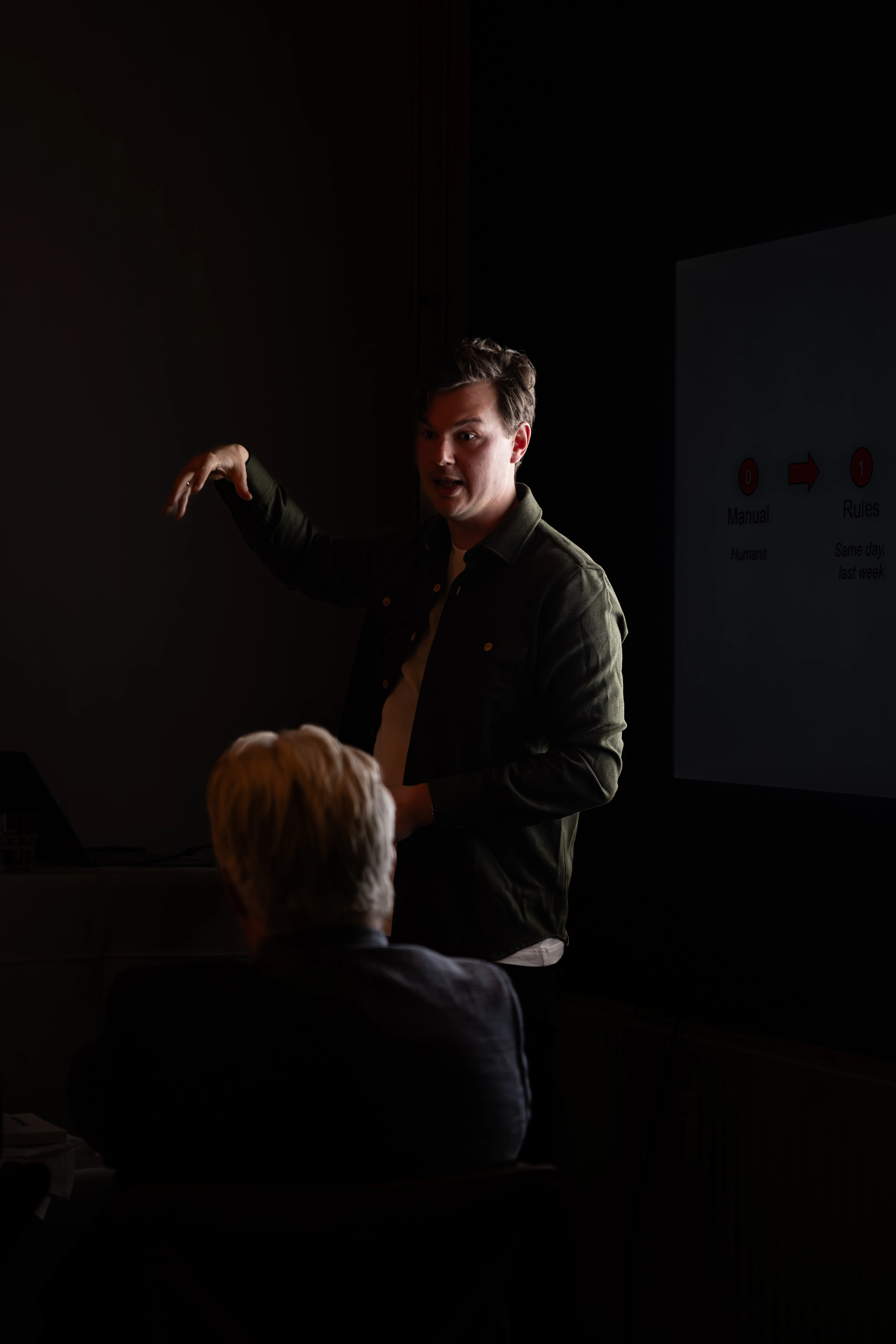
Jelmer Borst: Lessons from nearly a decade of AI at Picnic Technologies
After nearly ten years of implementing AI at Picnic, Jelmer’s takeaways were refreshingly grounded:
Start small and scale smart
It’s tempting to wait until everything is perfectly in place before launching an AI initiative, but that’s rarely how meaningful progress happens. Start small, even manually if the situation calls for it. The process of discovering edge cases takes time and can’t be cut short: it requires a willingness to experiment, to fail, and to keep testing until the pieces start falling into place. The messy early stages aren’t a sign that something is wrong. They’re how you build something that actually works at scale.
Value before technology
One of the most common mistakes organizations make is starting with the technology and working backwards. The more useful question isn’t “what can AI do?” but “what problem are we genuinely trying to solve?” Before reaching for a tool, take a step back and look at the core value your organization delivers to its customers. AI should serve that purpose, not define it. When you start from a real problem rather than a technical capability, you’re far more likely to end up with something that makes a meaningful difference.
Democratize data and AI
AI only reaches its potential when it’s treated as an organization-wide capability rather than a specialist function tucked away in one department. That starts with making data genuinely accessible to everyone, not just the teams who know how to query a database. When knowledge is centralized and people across the business can engage with it, AI stops being a tool that a few people use and starts becoming part of how the whole organization thinks and operates. That cultural shift is just as important as any technical implementation.
End-to-end ownership
Too often, AI and ML teams are brought in to build something and then handed off once it’s done, leaving the real-world complexity for someone else to figure out. That division tends to create gaps: in understanding, in accountability, and ultimately in results. When AI teams are involved from the initial scoping all the way through to value delivery, something shifts. The goals become shared, the decisions become better informed, and the outcomes reflect the full picture rather than just one piece of it.
Jelle Stienen: Why we’re all wrong when thinking about AI value
“We’re overestimating automation and underestimating coordination.”
Jelle Stienen
His perspective reframes where the real opportunity lies:
System over task
There’s a natural instinct to look at AI and immediately ask: which tasks can we automate? It’s an understandable place to start, but it tends to produce modest results. Shaving a few minutes off a manual process here and there adds up to very little if the underlying system remains the same. The more ambitious and ultimately more rewarding question is: how does this change the way we’re organized? When you shift the focus from automating isolated tasks to rethinking entire workflows and structures, that’s where AI starts to generate the kind of growth that actually moves the needle.
Coordination without consensus
Organizations are full of systems, teams, and data flows that exist in parallel but rarely communicate with each other. Historically, getting them to connect meant lengthy alignment processes, committee decisions, and a lot of waiting for everyone to agree on a direction. AI changes that dynamic. One of its less celebrated but genuinely powerful capabilities is its ability to bridge those gaps, linking systems and data streams that previously operated in separate units, without requiring full organizational buy-in before you can get started. That’s a meaningful shift in how change can happen inside a company.
Remove friction
The AI applications that generate the most headlines tend to be the most dramatic ones, but some of the most valuable implementations are far quieter. Every organization has invisible costs buried in the way work moves between people and departments: the delays, the miscommunications, the information that gets lost in translation between teams. These coordination costs are easy to overlook, precisely because they’ve always been there. But they represent real inefficiency, and they’re often exactly where AI can make the most tangible difference, not with a flashy product but by simply making things flow better than they ever have before.
The mood in the room
What struck us most wasn’t any single insight. It was the shift in how organizations are approaching AI. The era of extreme optimism and extreme skepticism is giving way to something more mature: a realistic, grounded understanding of what AI can and cannot do. How to create value is still a work in progress for many, but the path is becoming clearer. And the hunger for genuine knowledge, not vendor promises or hype, has never been greater.
In a moment when every conversation about AI seems to come with a sales pitch attached, an evening of real connection and honest dialogue, turned out to be exactly what everyone in that room had been looking for.
Thank you to everyone who joined us, and especially to Jelmer and Jelle for their openness and candor.